
Roofing marketing after a storm: win the work without looking like a storm chaser.
When storm searches spike, what homeowners are told to check, what you can and cannot say about an insurance claim, and how to ask for reviews without tripping Google.
Last reviewed November 20, 2026 against Google's own help pages. Google changes these rules often; if a step doesn't match what you see, trust the help page linked in Sources.
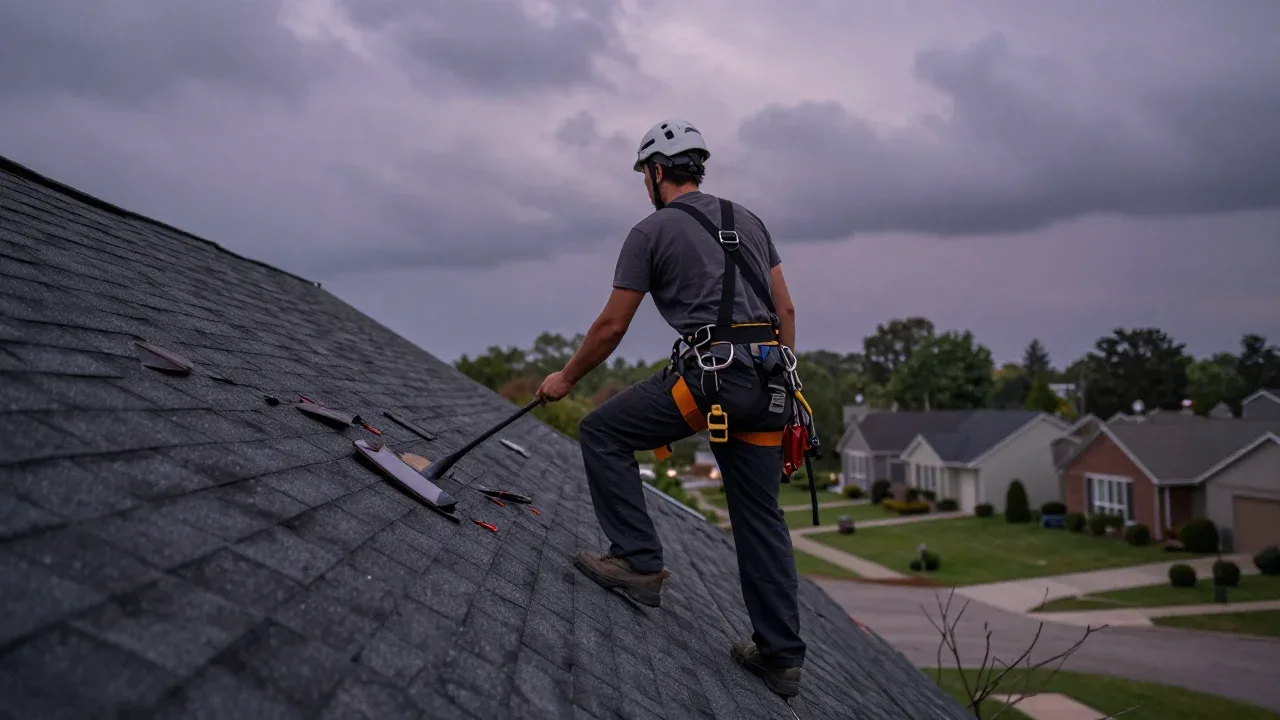
Roofing demand after a storm arrives all at once, and so does the homeowner's suspicion. To win that work, put proof of a real local business where homeowners look (license, permits, written contract), say nothing about insurance that your state's rules do not allow, and ask for reviews one finished job at a time so Google does not read your growth as manipulation.
01
When do roofing searches spike, and how fast?
Storm searches jump in weeks. Insurance-claim searches barely move. Here are twelve months of both.
02
Why do homeowners distrust a roofer who shows up after a storm?
Because their state tells them to. Government consumer alerts describe the same pattern, and tell homeowners exactly what to check.
| Homeowners are told to | Proof to show on your site and profile |
|---|---|
| Hire an established local contractor | Years in the area, real local job photos with the street or neighborhood named, and your service area on Google instead of an out-of-state number. |
| Check the roofing license and that its name matches the truck | Your license number with a link to the state lookup, and the exact same name on your truck, your invoices and your Google profile. |
| Confirm permits with the municipality | A short page on how you handle permits and inspections in your service towns. |
| Sign a written contract that names the work, materials, dates and warranty | A sample contract anyone can read before a visit. |
| Ask for lien waivers with each payment and never pay in full upfront | Your payment schedule and lien-waiver practice, in plain words. |
Your Google profile is part of that proof. A suspended profile looks like a vanished company, so keep it clean with the suspension-proof setup checklist.
03
What can a roofer say about an insurance claim?
It is state law, and the examples below are two states, not all fifty. Use them to see what a rule looks like, then look up yours.
Wisconsin: contractors cannot
Promise to pay any portion of an owner's property insurance deductible. Negotiate with an insurer on a customer's behalf (a contractor may discuss damages and costs with the insurer with the customer's permission).
Wisconsin: contractors must
Ask whether the work is related to an insurance claim before signing a contract, and tell customers they can cancel within three business days if the insurer denies any part of the claim.
Illinois: licensing lines
Public adjusters must be licensed by the state insurance department and roofers by the state financial and professional regulation department. If an insurer denies coverage on disaster repair, the homeowner can cancel within five days of the denial and within 30 days of receiving the proof of loss.
Illinois: warning on "free" inspections
The attorney general warns that scam operators may pose as public adjusters offering so-called "free" inspections to help owners file claims. If you offer an inspection, say what it includes and what it costs.
Three lines to keep out of ads, posts and phone scripts
Promises about approval
Nothing you say should suggest that the insurer will pay. You do not decide that.
Anything about your deductible
A promise to pay any part of it is barred in Wisconsin. Check your state before you write the offer.
Claiming to be an adjuster
Public adjusters are separately licensed in Illinois, and an Illinois consumer alert warns about scammers who pose as adjusters.
04
How do I handle a review spike after a storm?
A busy week produces real reviews. Google still reads patterns, so ask in a way that looks like what it is.
What Google says it removes
Content "exhibiting unusual volumes or patterns of review contributions that are indicative of efforts to manipulate a place's rating." It also bars incentives and selectively soliciting positive reviews.
Do: ask job by job
Send the review link when the work is finished and the customer has seen it. A steady pace avoids the burst pattern Google says it removes.
Do: reply to each one
Google asks you to be conversational, not promotional. Share a detail that reinforces the customer's experience.
Don't: text every past customer the same day
A sudden burst is the kind of unusual volume Google removes when it looks like manipulation. Space requests out as the jobs finish.
Don't: offer a discount or a gift
Incentives for posting, changing or removing a review are prohibited, including free or discounted goods or services.
Don't: tell staff to hit a number
Google lists asking staff to solicit a certain number of reviews, or reviews with specific content, as a violation.
Wait a few days before you panic
Google checks reviews against policy, which can take a few days. Removed reviews are not restored.
Templates for the request text are in how to get more Google reviews, and how to report a competitor buying reviews is for the rival who spikes by cheating.
05
Can I run Local Services Ads as a roofer?
Yes, with screening. Roofing is on Google's list, though it is not marked urgent the way HVAC, plumbing and electrical are.
Google lists roofing with the same four kinds of screening it uses elsewhere, each applied to select accounts: a business and owner background check, registration checks, general liability insurance and state licenses.
Google says roofing advertisers in the US were among the first groups to move from the Local Services Ads dashboard into Google Ads pay-per-lead campaigns, starting August 2026. Before you buy leads in a storm week, work out what a booked job costs you (cost per booked job by channel).
06
What does a 30-day storm plan look like?
Five stages, in order. The first one happens before anyone has a damaged roof.
-
Step 1: Before storm season, put your proof on the page homeowners land on
Show your license and the state lookup, local job photos, a sample written contract and how you handle permits. Make the name on all of it match the name on your truck and your Google profile.
- License
- Local jobs
- Sample contract
- Permits
Done when: a proof strip on your homepage and storm-damage page.
-
Step 2: In the first two days, answer the phone and say plainly what an inspection includes
State what is checked, what you hand over and what it costs. Make no promise about whether the insurer will approve anything.
Done when: one page or post that a skeptical homeowner could read in a minute.
-
Step 3: In week one, ask for a review when each job finishes
Send the Google review link after the work is done and the customer is satisfied or has had a chance to raise a problem. Offer nothing in return.
Done when: requests go out job by job, and each one is logged with a date.
-
Step 4: In weeks two to four, answer every review and every claim question in public
Reply to good and bad reviews with a fact, not a pitch. Turn the questions callers keep asking into short answers on the page.
Done when: no review older than two days without a reply.
-
Step 5: After the rush, check what you said against your state's rules
Read your ads, posts and scripts for any promise about deductibles, insurer negotiation or claim approval.
Done when: a dated note of what you changed, and the rule you checked it against.
Keep the weekly habits going after the rush with the 15-minute weekly Google profile routine.
Other questions owners ask
How do I show homeowners I am not a storm chaser?
State consumer advice for storm repairs tells homeowners to hire established local contractors and to check licenses, permits and written contracts. One state attorney general calls it a red flag when the name on a roofing license does not match the business card or truck. Put those proofs where a homeowner will look: your license, your local jobs, a sample contract and your permit process.
Can I offer to cover a homeowner's insurance deductible?
Not in Wisconsin: its consumer protection agency says contractors there cannot promise to pay any portion of an owner's property insurance deductible. Other states have their own rules, so check yours before you write the offer, and do not advertise it.
Can I ask all my past customers for reviews after a storm?
You can ask real customers for honest reviews, but Google removes content showing unusual volumes or patterns of review contributions that look like efforts to manipulate a rating, and it prohibits incentives and selectively soliciting positive reviews. Ask after each finished job rather than in one burst, and do not ask only the happy ones.
Why are my new roofing reviews not showing on Google?
Google says reviews are checked against its policies, which can take a few days, that reviews removed for policy violations are not restored, and that it may temporarily disable user-created content for certain profiles or business categories. Wait a few days before treating it as a problem, then read Google's page on missing or delayed reviews.
Do roofers need a license to run Local Services Ads?
Roofing is a Local Services Ads category with screening. Google lists business and owner checks, business registration checks, general liability insurance and state-level business and owner licenses as requirements for select accounts. Its requirements page marks HVAC, plumbing and electrical as urgent categories but does not mark roofing that way.
Sources (10)
- Google Ads Keyword Planner monthly US search volumes, Nov 2025 to Oct 2026, pulled through DataForSEO on 2026-11-20
- Wisconsin DATCP: After Storm Damage, Stay Protected When Seeking Repairs (April 18, 2025)
- Illinois Attorney General: Consumer alert on storm-related repair scams (May 27, 2025)
- Maps User Generated Content Policy: Prohibited & restricted content
- Google Business Profile Help: Tips to get more reviews
- Google Business Profile Help: Create a Google link or QR code to request reviews
- Google Business Profile Help: About missing or delayed reviews
- Local Services Ads Help: Business screening and verification requirements (United States)
- Google Ads Help: Local Services Ads transition to Performance Max campaigns with pay-per-lead goals
- Google Business Profile Help: Guidelines for representing your business on Google
Why we wrote this. Roofers told us storm chasers poison trust before they say a word, and that insurance work squeezes them (how we did the research). We used two state consumer alerts for the claim rules, Google's own review policy for the review advice, and a fresh pull of monthly search volume, then dated the page.

Free, no call needed